

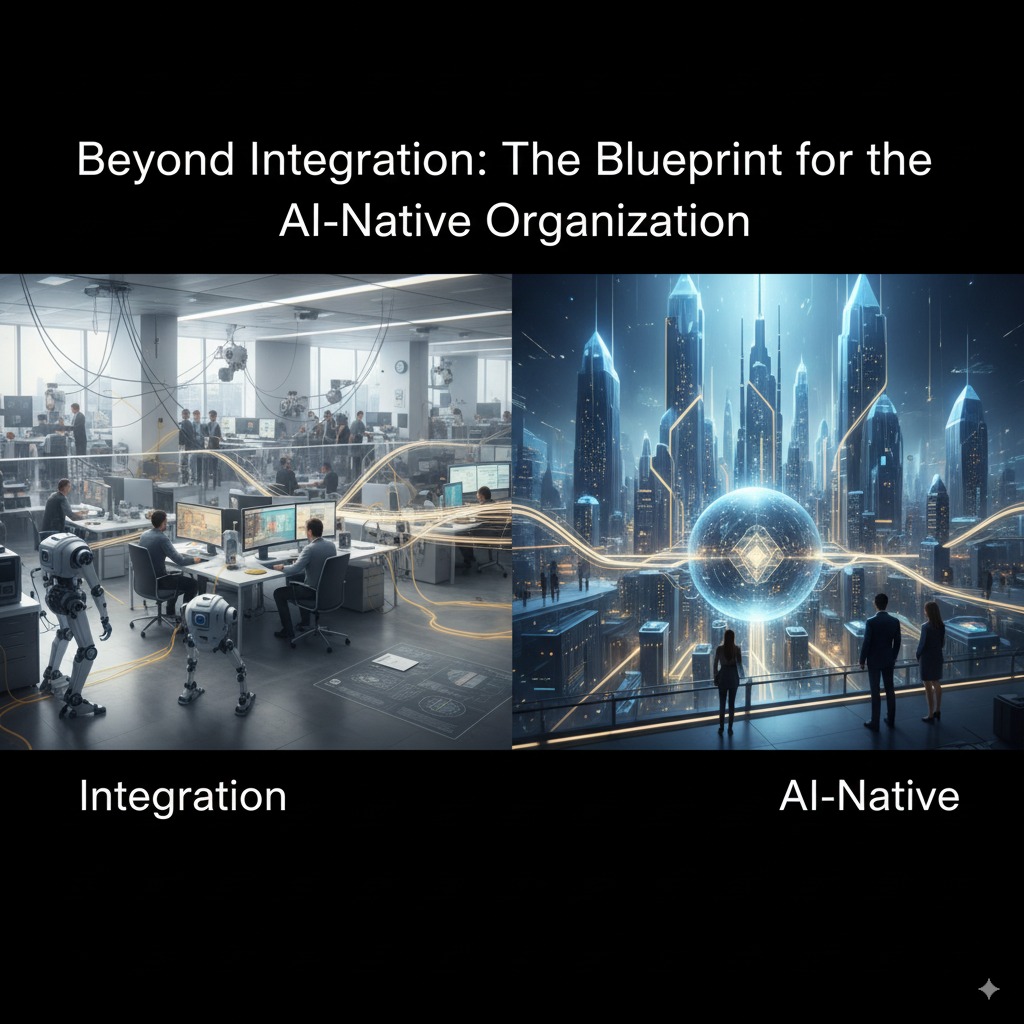
For the past year, nearly every boardroom has asked the same question: “What is our AI strategy?” Most have settled for a depressingly timid answer: integrating AI tools into existing workflows. They’re putting a faster engine in a horse-drawn carriage. This is a failure of imagination. The real opportunity isn’t to use AI; it’s to become AI-Native.
An AI-Native organization is fundamentally different from a legacy company that simply uses AI. It’s a business that is architected from the ground up with an intelligent core, treating AI not as a tool, but as its central nervous system.
Here is the blueprint for this new type of organization:
A Central AI Core: Instead of dozens of disconnected AI tools, the AI-Native org has a single, integrated intelligence—like what we’re building with AIfrit. This core has access to all departments (sales, marketing, operations, HR) and understands the business as a holistic entity. It doesn’t just optimize tasks; it optimizes the entire system.
Data as a Utility: In legacy companies, data is a resource to be mined. In AI-Native companies, real-time data is a utility, like electricity, flowing constantly into the AI core. Every email, every sales call, every support ticket is a signal that informs the central intelligence.
Autonomous Workflows, Not Automated Tasks: Automation is about making a single task faster. Autonomy is about giving the AI a strategic goal and letting it orchestrate the complex sequence of tasks required to achieve it. Example: Instead of “automate expense reporting,” the goal is “AI, manage the Q3 travel budget to stay 5% under forecast while maximizing team presence at key industry events.”
Human-on-the-Loop Leadership: The role of human leaders shifts from micromanagement to strategic oversight. Leaders are no longer in the weeds; they are “on the loop,” setting the vision, defining the ethical guardrails, and asking the critical questions that guide the AI core.
Building an AI-Native organization is not an IT project. It is a complete redesign of the corporate chassis. It is the most significant competitive advantage a business can build today, and those who start architecting now will be the undisputed leaders of the next decade.